
Menu
Navigate • Search • Jump
Type to filter • Switch tabs to browse more
Explore the project, support the fundraising campaign, and join related roles.
Project overview, solution, problem, context, and execution plan.
Project Overview
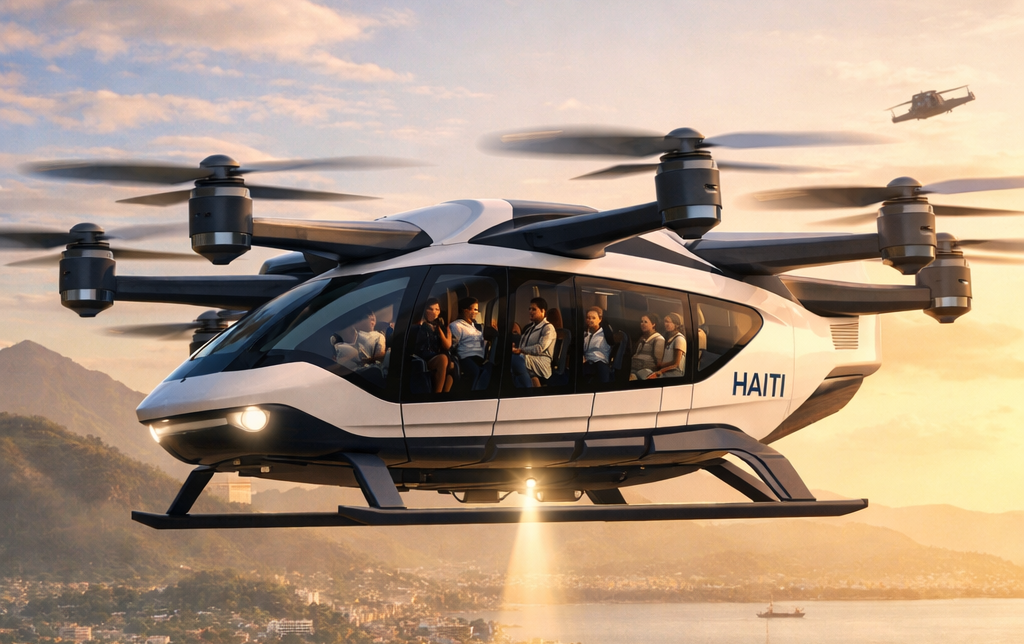
The Flying Taxi Robot for Haiti is a long-term innovation project focused on exploring an electric aerial transportation system adapted to Haiti’s realities. The project imagines a safe, practical, and scalable flying taxi capable of helping people move above traffic congestion, damaged roads, and difficult terrain.
This project will begin with research, simulations, design work, and a small prototype before any large-scale development. Its main goal is to help AiTWobo members learn, build, and grow technical skills in robotics, electrical systems, mechanical design, control systems, and aerial mobility.
Problem
Transportation in Haiti is often slow, unreliable, and difficult. Traffic, poor road conditions, and limited infrastructure affect workers, students, families, and emergency services. Some areas remain hard to access, and emergency response can be delayed.
Proposed Solution
The proposed solution is an electric flying taxi robot with vertical takeoff and landing capability. The long-term vision is a vehicle that could carry up to ten passengers while operating in compact urban or semi-urban environments. Human control and safety oversight would remain central, while automation would support stability, navigation, and assistance.
Expected Impact
This project could inspire a new generation of Haitian engineers and innovators. Even a small prototype could prove that advanced robotics and future mobility ideas can begin in Haiti. It can also create opportunities for learning, research, partnerships, and long-term innovation in transportation.
Main Features
Electric propulsion, vertical takeoff and landing, sensor-based awareness, semi-autonomous support, rechargeable battery power, human-controlled operation, and modular development through simulation and prototyping.
Team Skills Needed
Electrical engineering, robotics, mechanical design, CAD, embedded systems, control systems, battery systems, aerodynamics, safety analysis, and project management.
Public roles needed to build, research, test, and grow this project.
People currently connected to this project.
AiTWobo does not yet have all the technical capacity required to build a full-scale flying taxi. This project should be understood as a serious learning and research pathway. The first step is to focus on skills, simulations, and a small prototype before considering larger development.
If the embedded call does not load, open the room in a new tab.
