

Self-Balancing Two-Wheel Robot

AiTWobo Build & Learn · Select a country and session

Build & Learn • Course Session

Self-Balancing Two-Wheel Robot

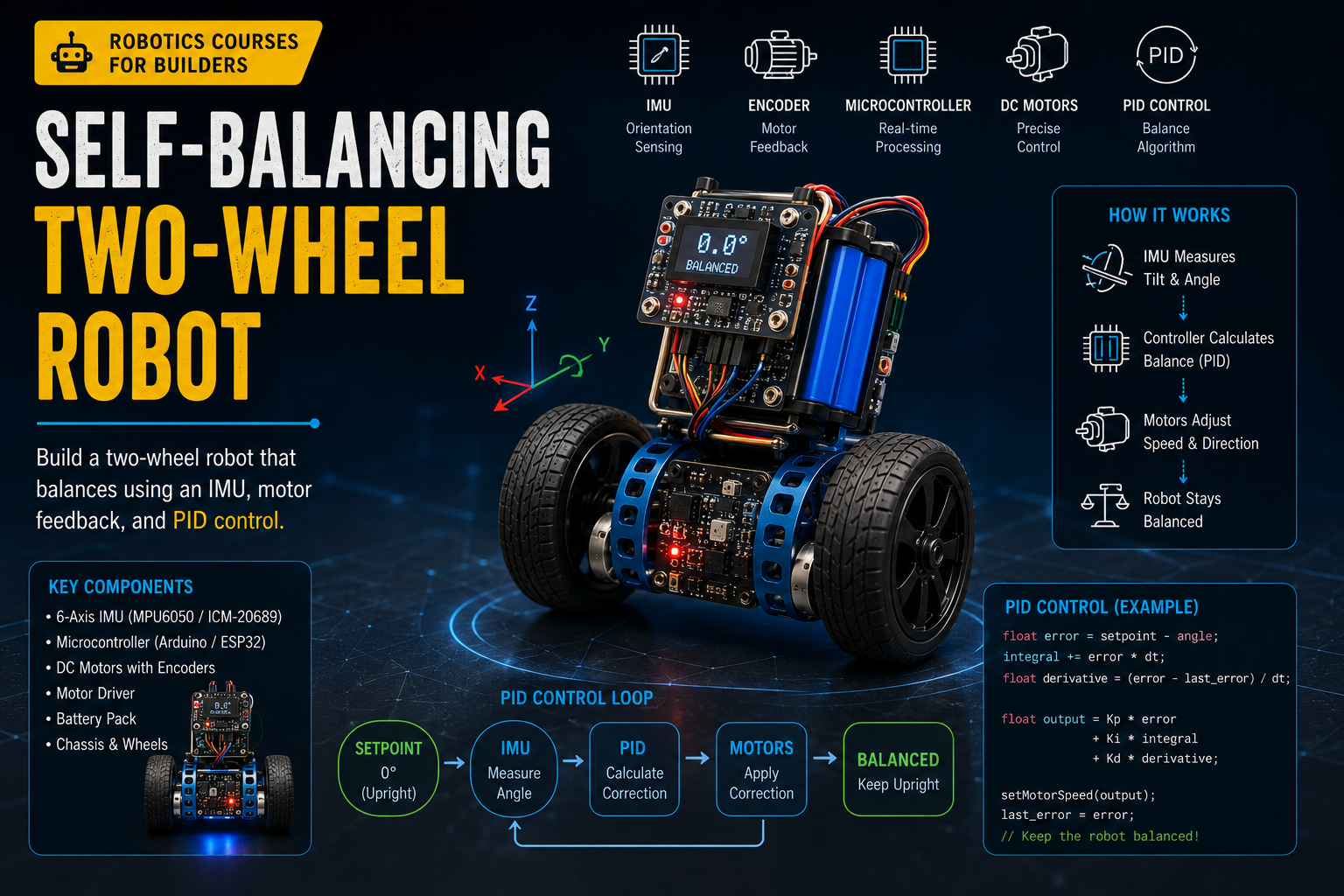
Build a two-wheel robot that balances using an IMU, motor feedback, and PID control.
Open self-balancing-robots In person + guided practice Advanced 8 weeks
Course outline
Your course progress0/0 lessons • 0%
Self-Balancing Two-Wheel Robot course cover
Build • Wire • Program • Test

Self-Balancing Two-Wheel Robot is a mentor-led Build & Learn robotics project. Participants design, assemble, program, test, document, and present a working robotic system.

Project outcomes

  • Plan the robot and identify system requirements.
  • Integrate the required mechanical, electrical, and software components.
  • Test performance, troubleshoot problems, and improve the design.
  • Document the build and demonstrate the completed robotics project.
Chapter & Location

• No session available

No session available

USD

Schedule

No session available

America/New_York

Duration

16 guided hours

8–12 hours independent practice

Completion

Final robot demonstration

Certificate included

Available course sessions

Choose the chapter, country, location, and schedule that work for you. Course lessons and learning content remain the same for every session.

No session available. A course session must be created in the database before registration can open.

Course content

Follow 1 modules and 0 lessons from fundamentals to final demonstration.

Explain the purpose and main subsystems of the robot or technical system.
Identify the mechanical, electrical, electronic, and software components used in the build.
Assemble the project using safe and organized construction practices.
Create and verify power, signal, sensor, and actuator connections.
Program the required behaviors with readable and reusable code.
Use systematic testing to diagnose mechanical, electrical, and software problems.
Document design decisions, test results, and improvements.
Demonstrate a functioning final project and explain how it works.

Final challenge

Complete and demonstrate the required robotics project using safe construction, organized wiring, reusable code, structured testing, and technical documentation.

Required evidence: Working robot, source code, wiring diagram, build photos, test results, and a short reflection.